
Abloy is shifting focus from targeting carbon neutrality regarding own operations to cutting its value chain emissions


Abloy has made the decision to discontinue the use of the term carbon neutral in our goal setting order to ensure its climate communications remain up to date, credible, and in line with the latest sustainability communication practices, such as the EU Consumer Rights Directive, UCPD directive and the upcoming Green Claims directive.
Abloy set its goal in 2021 to make the Joensuu factory carbon-neutral by 2025. The goal was based on the PAS 2060:2014 standard, which authorized companies to set uniquely identified carbon neutrality targets, such as achieving carbon neutrality regarding scopes 1 and 2. The standard stated that after emissions are first reduced based on a goal-oriented reduction plan the remaining emissions must be offset with purchasing high-quality carbon credits.
“What matters most to us is that our communication reflects current expectations and standards – even when it means re-evaluating our goals or terminology. We want to communicate transparently about our progress regarding our emission cut journey and to not use terminology that can be misleading or misunderstood.”, says Enssi Savolainen, Health & Safety and Sustainability Manager at Abloy.
Why we moved away from carbon neutrality target
The original carbon neutrality target regarding our own production was based on PAS 2060, which has been withdrawn since the 1st of January 2025. It has been replaced with ISO 14068-1:2023 standard, which requires taking into consideration all emissions of an organization (scopes 1, 2 and 3) to reach carbon neutrality.
While the original goal was realistic when focused solely on Abloy’s operational emissions, meeting the new requirements would demand large-scale offsetting across the entire value chain.
“We explored various options together with experts from Sweco. If we had continued to aim for carbon neutrality under ISO 14068, we would also have needed to take our Scope 3 emissions into account. According to the emissions hierarchy, companies must first avoid, then reduce and replace emissions before considering offsetting. Therefore, we must tackle our Scope 3 emissions in these three ways before we can even begin to think about compensation. We still have a lot of work to do on our Scope 3 emissions,” says Anna Varis, Environment and Sustainability Specialist at Abloy Oy.
“The way the term ‘carbon neutral’ is used and perceived has also changed significantly in recent years. Using it no longer aligns with sustainability
communication standards, so we no longer want to use it in this context”, she continues.
For these reasons, Abloy does not see offset-based compensation as a realistic or meaningful solution within its strategy at the moment.
Abloy’s own operations emissions near zero – equivalent to approximately seven Finns
While the terminology has changed, the target has not: Abloy remains committed to eliminating all own operation emissions including all emissions from Joensuu factory. We have been committed to an ambitious long-term climate work for over a decade, and the results are now visible. By the end of 2024, our own operations annual emissions are down to approximately 51,2 of tCO2e – equivalent to the approximate average annual emissions of just seven Finns.
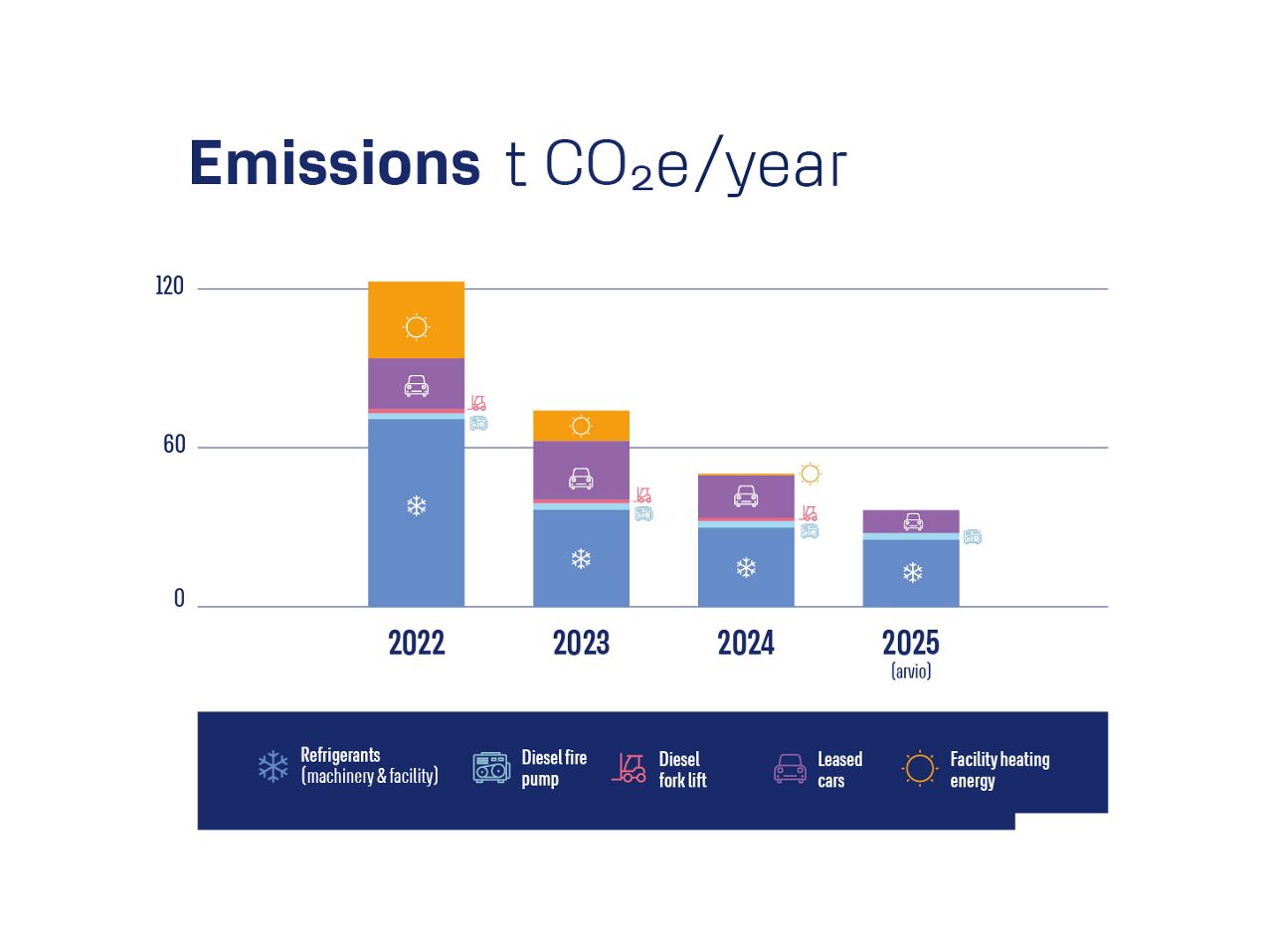
These reductions have been achieved through a broad set of measures:
- 100 % renewable electricity and district heating.
- Cooling system modernization: In 2023, Abloy invested to replace old refrigerants and cooling units with more environmentally friendly alternatives.
- Company-car electrification: Starting in 2025, all new company vehicles will be fully electric, unless a justified exemption is granted. The last hybrids and combustion engine vehicles will be phased out by 2027.
- Facility energy efficiency upgrades and accurate emissions tracking.
“We’ve come a long way to reach this point. Even though the remaining emissions are small, we continue to look for ways to reduce them – for example through further upgrades to cooling systems and building infrastructure”, says Enssi Savolainen.
Shifting focus to value chain emissions (Scope 3)
More than 99 % of Abloy’s total emissions come from Scope 3 sources: purchased materials, logistics, product use, and end-of-life treatment. In other words, a big part of the work is still ahead.
As part of the ASSA ABLOY Group, Abloy is committed to the Science Based Targets initiative (SBTi). At Group level, the target is to reduce Scope 3 emissions by 28 % by 2030, compared to a 2019 baseline. Abloy is actively contributing to this goal by concentrating especially on production quality, sustainable procurement, lower emission logistics, as well as product innovation in accordance with the 2024 launched key emission reduction workstreams.
“Reducing Scope 3 emissions doesn’t happen overnight, but we are now building the systems and partnerships to make it possible. This is a shared challenge across our industry, and we want to be among the leaders”, says Anna Varis.
Responsible participation in carbon markets – research before claims
While Abloy is not currently using carbon offsets in its climate strategy, the company is carefully exploring under what conditions it could participate in domestic climate initiatives in the future. To support this, Abloy has launched a master’s thesis collaboration with LUT University. The study will assess how the company might credibly engage with carbon markets – without risk of misleading claims, double counting, or questionable additionality. The goal is to lead by example in responsible, evidence-based climate action.
The outcome: credible long-term sustainability work
Abloy’s decision to move away from carbon neutrality target demonstrates its commitment to responsible climate communication. The focus is even more than before on transparently reported actions, measurable progress, and continuous improvement. This builds trust and lays the foundation for our long-term SBTi goal: achieving net-zero emissions across the entire value chain no later than 2050.
“Our message is simple: our climate work continues at full strength. We’re no longer using the term carbon neutral in our sustainability targets, but not because we care any less about our emissions – quite the opposite. We want to do this the right way”, concludes Enssi Savolainen.